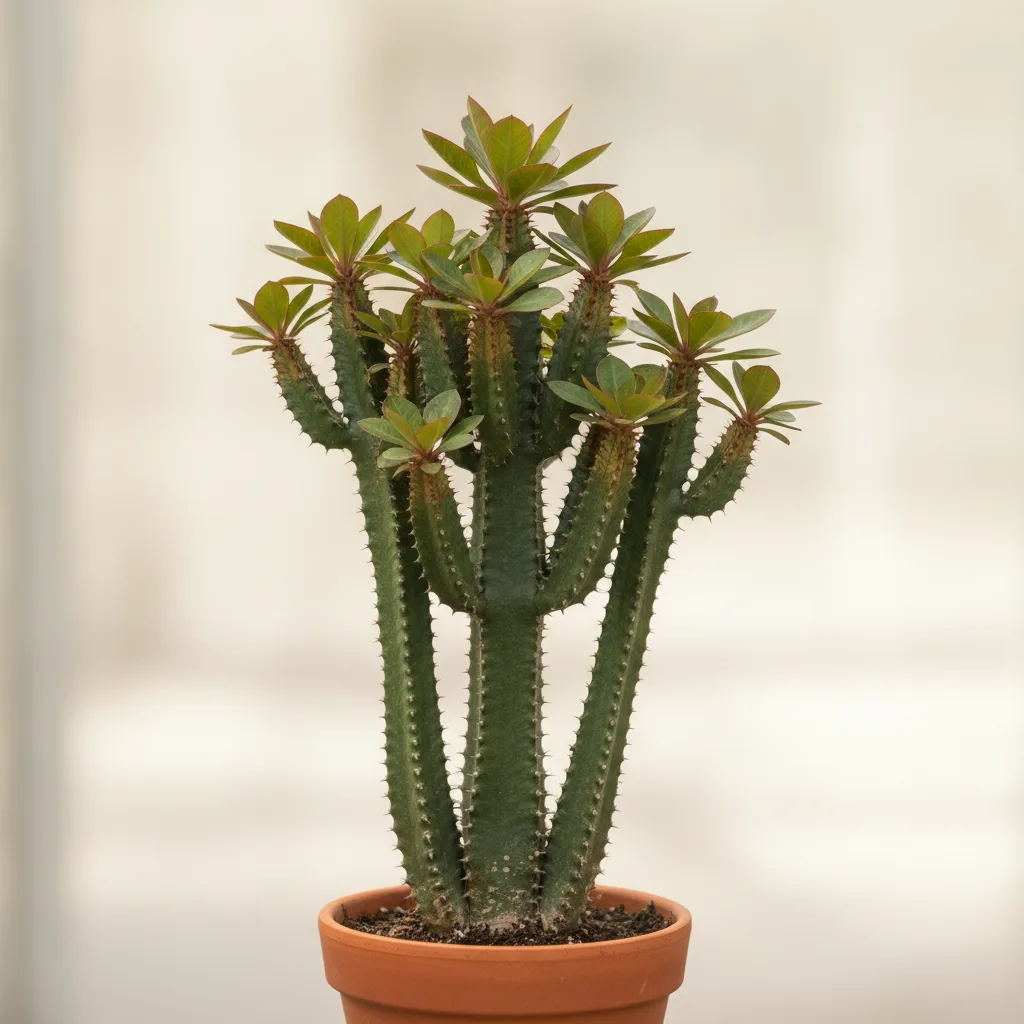
An upright branching succulent with three-sided green ridged stems lined with small paired spines and teardrop leaves, exuding an irritant milky sap. A fast architectural feature, often mistaken for a cactus.
At a glance
- Plant type: Succulent
- Mature size: 2 m H × 60 cm W
- Aspect: full sun and part shade or morning sun
- Water: very drought tolerant once established
- Frost: tender
- Maintenance: low maintenance
- Origin: Exotic
About African Milk Tree
Euphorbia trigona is a moderate-growing succulent in the Euphorbiaceae family. It reaches around 2 m tall and 60 cm wide at maturity, with evergreen foliage.
Where to grow African Milk Tree
African Milk Tree suits arid and semi-arid, warm-temperate and subtropical climates and grows best in full sun and part shade or morning sun. It is frost tender, so protect it from hard frosts or grow it in a sheltered spot or pot. It also is a genuinely water-wise choice.
Soil & planting
African Milk Tree does best in sandy and free-draining soil. Plant into well-prepared ground, firm the soil around the roots and water deeply to settle it in.
Watering & feeding
African Milk Tree handles dry conditions well once established. Apply a balanced fertiliser in spring to support healthy growth. Check moisture below the mulch during establishment and water thoroughly when needed rather than following a rigid schedule.
Pruning & care
Tip-prune African Milk Tree in spring to maintain a dense, shapely habit. Its ongoing care level is low maintenance.
Using African Milk Tree in the garden
African Milk Tree earns its place for pots and courtyard containers and a feature or specimen planting. It is equally at home in the ground or a large pot on a balcony or courtyard.
Companion planting & design
Build the planting around neighbours suited to the same dry conditions once established and arid and semi-arid climate as African Milk Tree. Repeating the foliage or flower colour nearby will make the composition feel deliberate.
Good to know
Note that it is toxic to cats and dogs, so site it away from pets that chew. It is thorny — useful as a barrier, but wear gloves when pruning.
Buying African Milk Tree
Plant Sale lists African Milk Tree as potted plants. Use the quote builder above to check current sizes, pricing and availability before ordering.