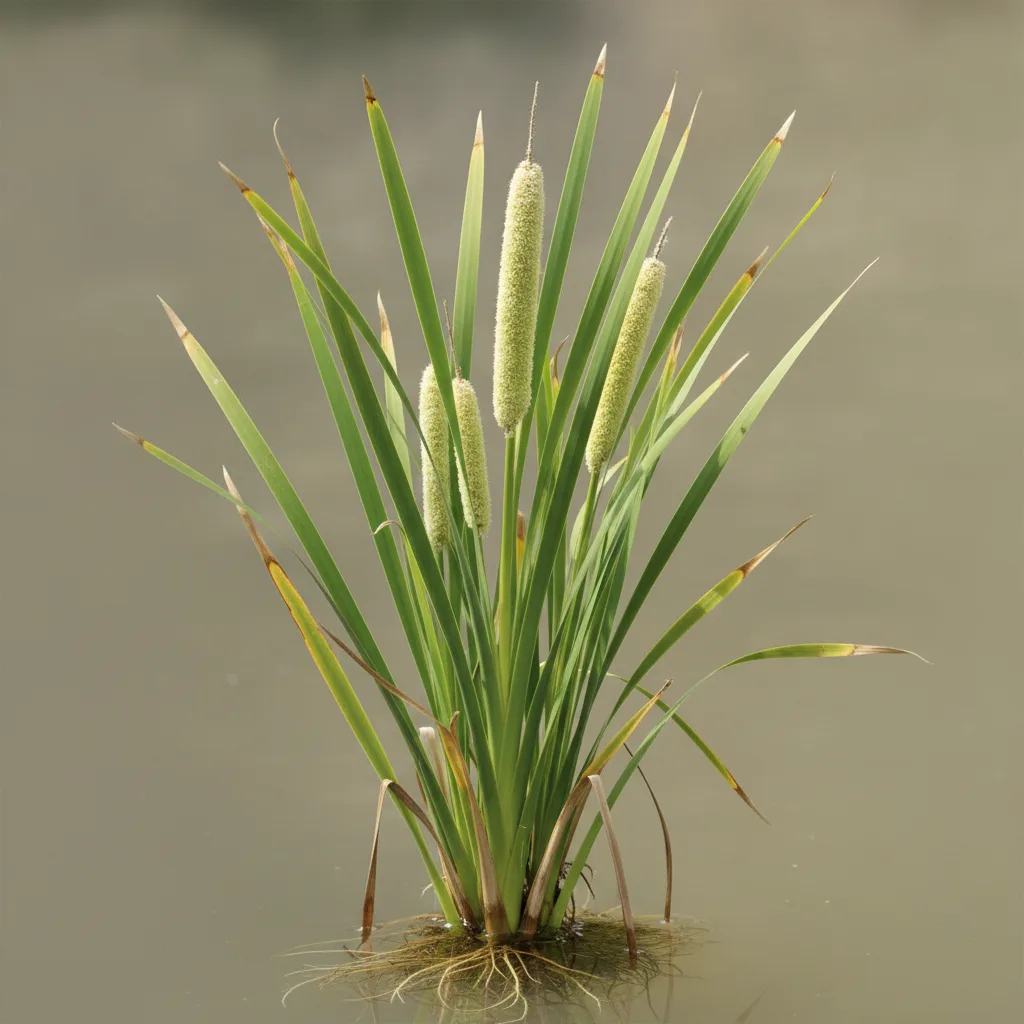
A vigorous native marginal reed with strappy upright leaves and the familiar brown cigar-shaped seed heads. Spreads strongly, so best confined to large dams and natural wetlands.
At a glance
- Plant type: Aquatic plant
- Mature size: 2.5 m H × 1 m W
- Aspect: full sun
- Water: wet or boggy ground
- Frost: hardy
- Maintenance: moderate maintenance
- Origin: Australian native
About Cumbungi
Typha orientalis is a fast-growing aquatic plant in the Typhaceae family, native to Australia. It reaches around 2.5 m tall and 1 m wide at maturity, with deciduous foliage. Cream green flowers appear in summer.
Where to grow Cumbungi
Cumbungi suits tropical, subtropical, warm-temperate and cool-temperate climates and grows best in full sun. It is frost hardy and shrugs off cold winters.
Soil & planting
Cumbungi does best in clay soil. Plant into well-prepared ground, firm the soil around the roots and water deeply to settle it in.
Watering & feeding
Cumbungi is adapted to wet or boggy ground. As an Australian native, feed it only with a low-phosphorus native fertiliser. Check moisture below the mulch during establishment and water thoroughly when needed rather than following a rigid schedule.
Pruning & care
Prune Cumbungi after flowering to keep it compact and encourage the next flush of blooms. Its ongoing care level is moderate maintenance.
Using Cumbungi in the garden
Cumbungi earns its place for holding soil on banks and slopes and a feature or specimen planting.
Companion planting & design
Build the planting around neighbours suited to the same wet or boggy ground and tropical climate as Cumbungi. Repeating the foliage or flower colour nearby will make the composition feel deliberate. It combines naturally with other Australian natives in a habitat or water-wise garden.
Good to know
Be aware it can self-seed or spread into bushland in some regions — check it is not a declared weed in your area before planting.
Buying Cumbungi
Plant Sale lists Cumbungi as potted plants. Use the quote builder above to check current sizes, pricing and availability before ordering.